
What is an RPZ device?
Water in the city mains sits at pressure so it flows out of your taps. When that pressure drops, from a main break or a heavy draw on a nearby hydrant, water inside a building can travel backward toward the street. Anything connected to that plumbing can move with it: irrigation lines, boiler feed water, the equipment in a commercial kitchen.
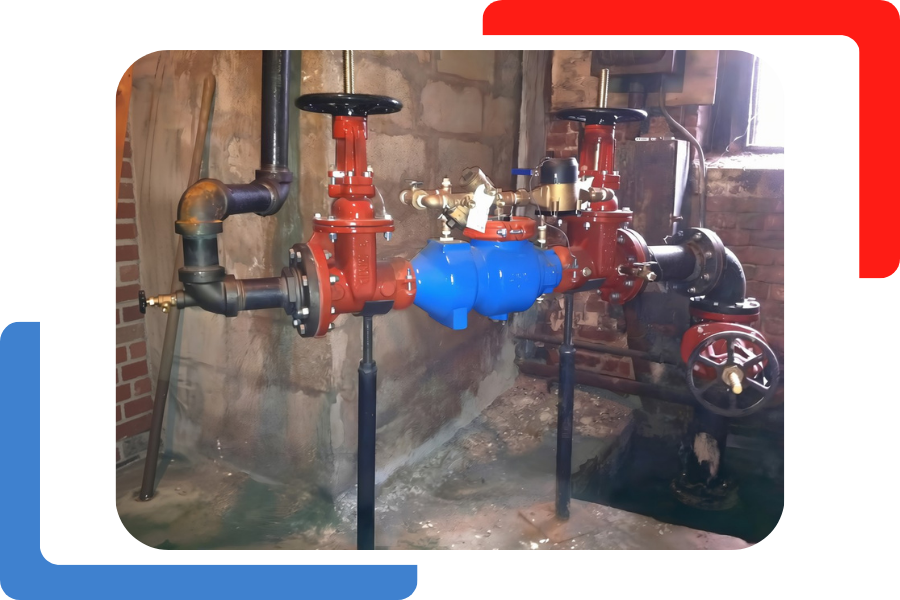
An RPZ, or reduced pressure zone device, sits between your water service and the main and stops that reversal. The DEP requires one wherever it has identified a contamination hazard, and it must carry a passing certification when it goes in and every year afterward.
What does NYC require for annual backflow prevention testing?
Four things, in order:
- A New York State-certified Backflow Prevention Device Tester performs the test.
- A NYC Licensed Master Plumber signs the test documentation.
- The initial report reaches the DEP within 30 days of installation.
- Each annual report follows within twelve months of the one before it.
The clock runs from the date of the last filed report. So a building certified in March comes due again the following March. Until a passing test reaches the file, a lapsed device stays out of compliance, and an open water service issue can surface on the building record alongside other DOB and DEP violations.
What backflow prevention looks like in a Brooklyn building
Brooklyn building stock complicates the physical installation more than the paperwork. In pre-war multifamily buildings and attached rowhouses, the water service usually enters through the cellar, into a space nobody laid out for a device that needs clearance on every side and a drain beneath it. An RPZ discharges water when it does its job, so it cannot sit above a boiler, an electrical panel, or a tenant storage area.
Attached buildings add a second constraint. Because there is no side yard to stage from and no free exterior wall for a new line, the device has to find a home in the space that already exists. On mixed-use buildings, meanwhile, the commercial tenant whose equipment triggers the requirement is often the tenant least able to lose water during the workday.
Those constraints decide where the device goes and how long the shutdown runs. They are worth walking before the plan goes in.
Does my building need backflow prevention?
It depends on what connects to the water service rather than on the size of the building.
A one-family or two-family home on a single domestic service often escapes the containment requirement at the main, provided no in-ground sprinkler system, pool, or similar hazard sits on the line. Add in-ground irrigation, however, and that exemption generally goes away.
Mixed-use buildings work differently. A ground-floor commercial kitchen, laundry, or medical office usually puts the building in the commercial category, and the DEP will then typically require a containment device on the service line even where the floors above stay residential.
A New York-licensed Professional Engineer or Registered Architect makes that determination. They carry out the hazard assessment, design the backflow prevention plan, and file it with the DEP for approval.
How we handle backflow prevention
We coordinate the hazard assessment and the engineer's DEP filing, install the device, and carry the annual test from there. A New York State-certified Backflow Prevention Device Tester performs the testing, and we file the work under our NYC Master Plumber license, #2296.
For the full permit and filing sequence, see our guide to backflow prevention devices in NYC.
What Our Customers Are Saying

Mr. Alex Lewis and his technical team were very responsive, professional and personable... works very hard at finding me a solution.
— Roberta F. —
Everything was handled promptly and professionally... Communication was excellent. The technician arrived right on time.
— Philip N. —
Fast, efficient, very smart, hard working and courteous. Got my Gas Piping up to code - passed the Grid Inspection.
— Valerie C. —